The project
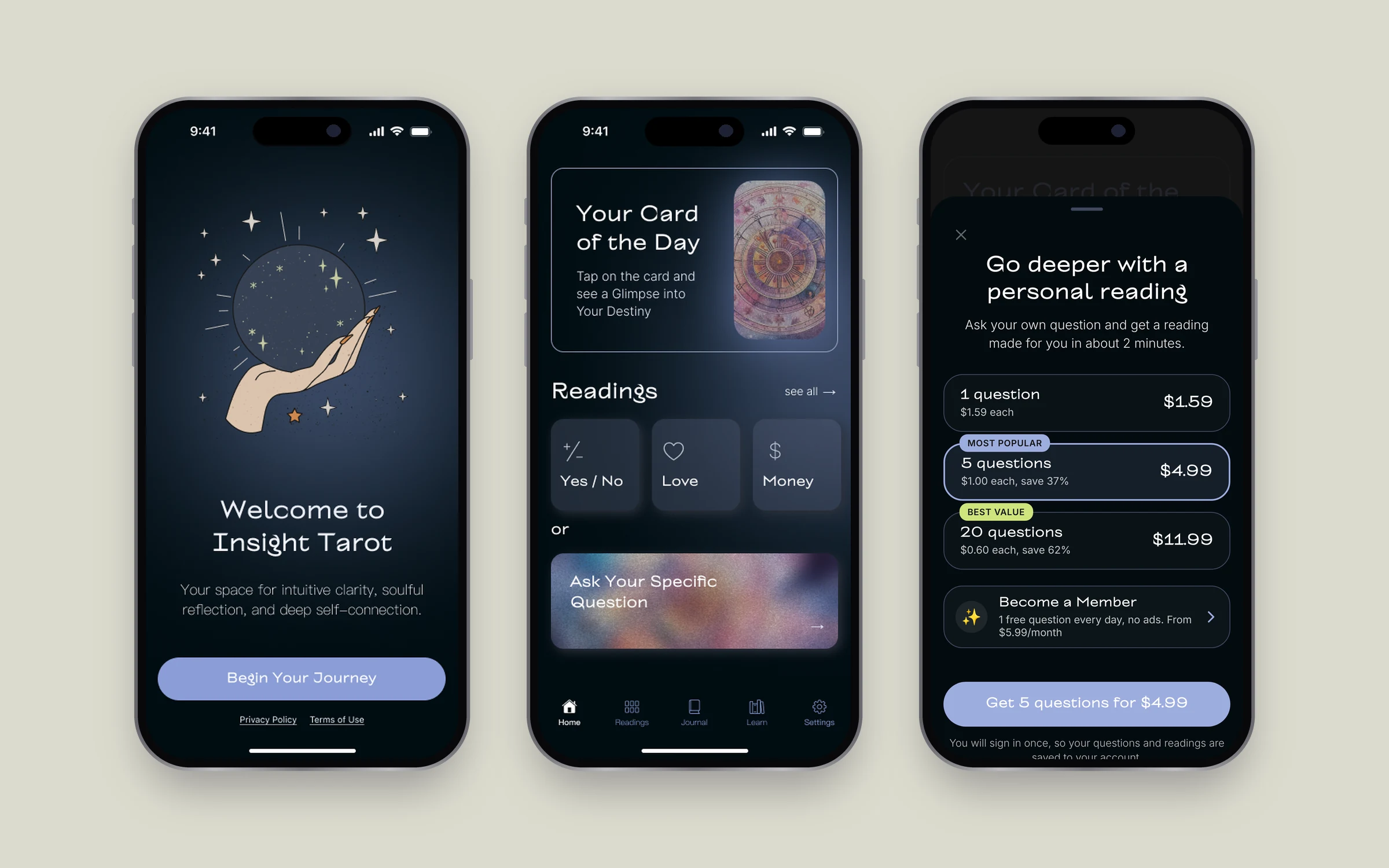
Insight Tarot is a mobile app for tarot readings, built for self-reflection rather than fortune-telling. A card is a prompt: it gives you words for a question you already carry, and a calm space to think it through. I led the product and the design end to end, for iOS and Android, and shipped it with a developer.
The idea
Most tarot apps promise predictions. Insight Tarot is about meaning, interpretation and an inner dialogue, so the design stays quiet: a dark, starry interface, one question per screen, and copy that asks you to focus on yourself and your own decisions, not on what will happen.
What it does
- Card of the day. A small morning ritual: tap the card and read a short personal message.
- Readings by topic. Love, money, career, Yes/No, or a classic spread such as Past, Present, Future.
- Your own question. Ask something specific, with short tips on how to phrase it so the answer is useful.
- Got real cards? Photograph your own deck and the app reads the cards you laid out.
- Journal. Save a reading and come back to it later to see how your view changed.
Screens
A dark canvas, soft gradients and a hand-drawn set of stars, moons and eyes. The card or the question is always the brightest thing on the screen.
New paywalls
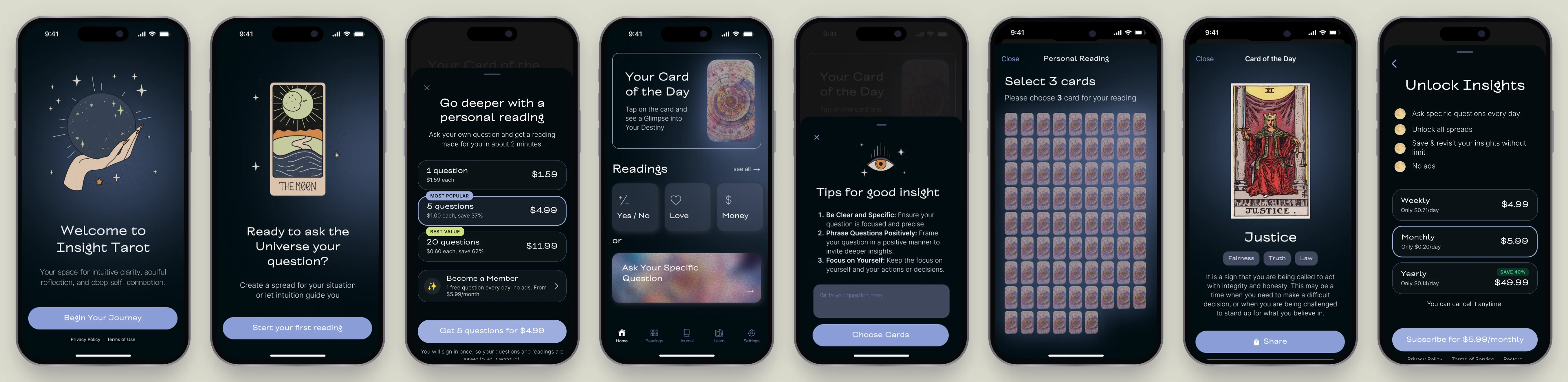
The latest work is the question-pack and subscription flow, designed to be clearer and calmer. Packs became cards with “Most popular” and “Best value” marks, and each discount is calculated from the store price, not typed in by hand. There is one main button, and “Become a Member” sits apart in a quieter style so nobody mistakes it for the paywall.
The sign-in step says what happens next: you only do this once, and there is no charge yet. In the subscription sheet the close button became a back arrow, and every plan shows its price per day.
Early numbers
The app is young, and so is the data. In the 28 days to 24 November 2026, RevenueCat shows 152 new users and 184 active users, with $61 in revenue. These are small samples, so I read them as direction and not as proof: no conversion percentages, only what I can see in the product.
I track the product in PostHog, with Ukraine and dev builds excluded, and cross-check purchases against RevenueCat. Version 2.8.1 is counted only from its public release (14 November on iOS, 13 November on Android). Onboarding applies to new users only and the paywall appears only after an action, so I compare new and returning users separately.